Digital signage software for the screens you already own
One dashboard for every TV in every shop: the menu, the offers, the video — and the ads that pay for them. No player box. Every feature on every plan.
Optional — everything works in the browser. The apps add a true full screen and start with the machine; the install page has the steps.
- Ten-minute setup
- Any TV or PC you have
- Plays 7 days offline
- Ads you approve
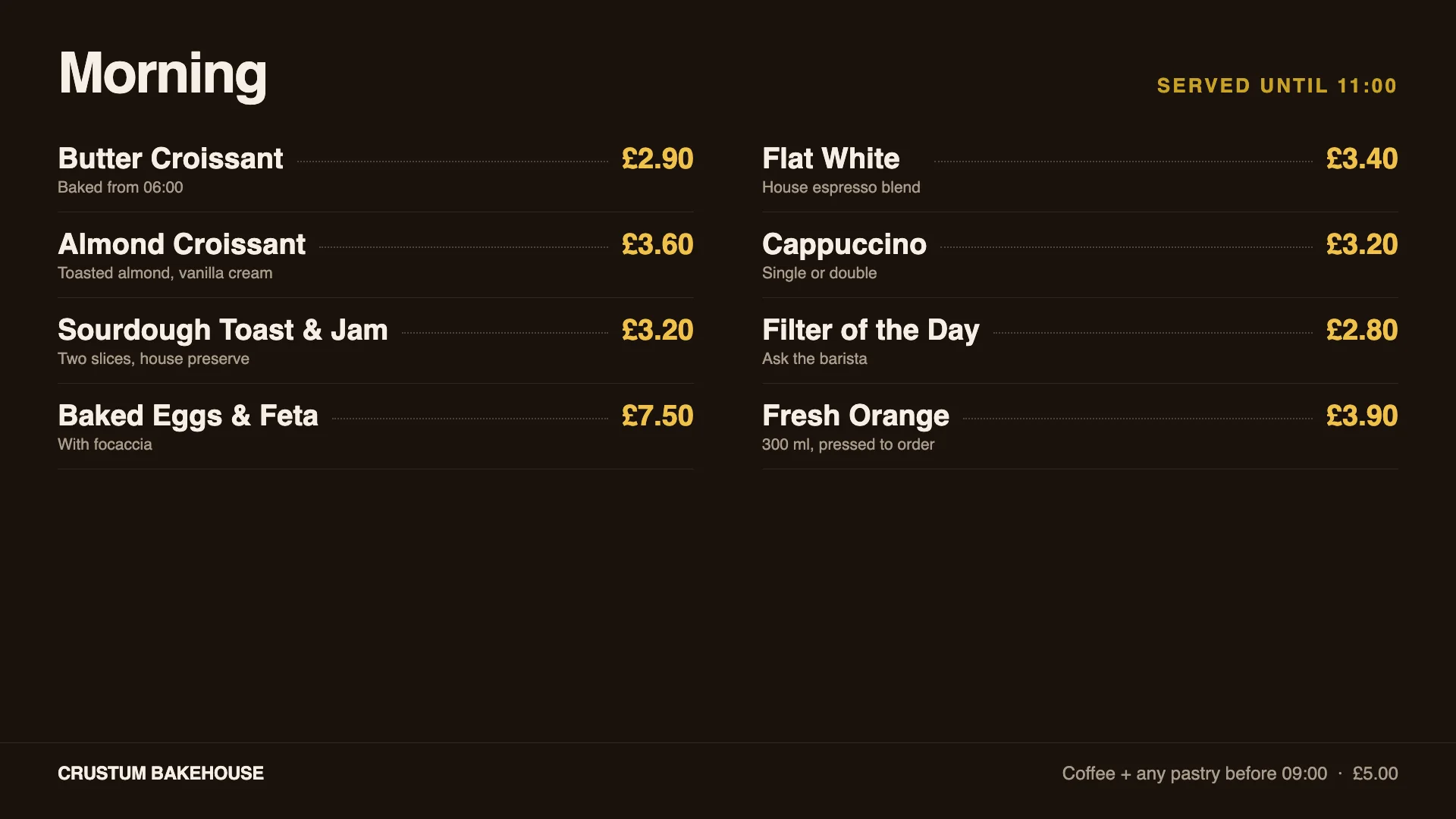
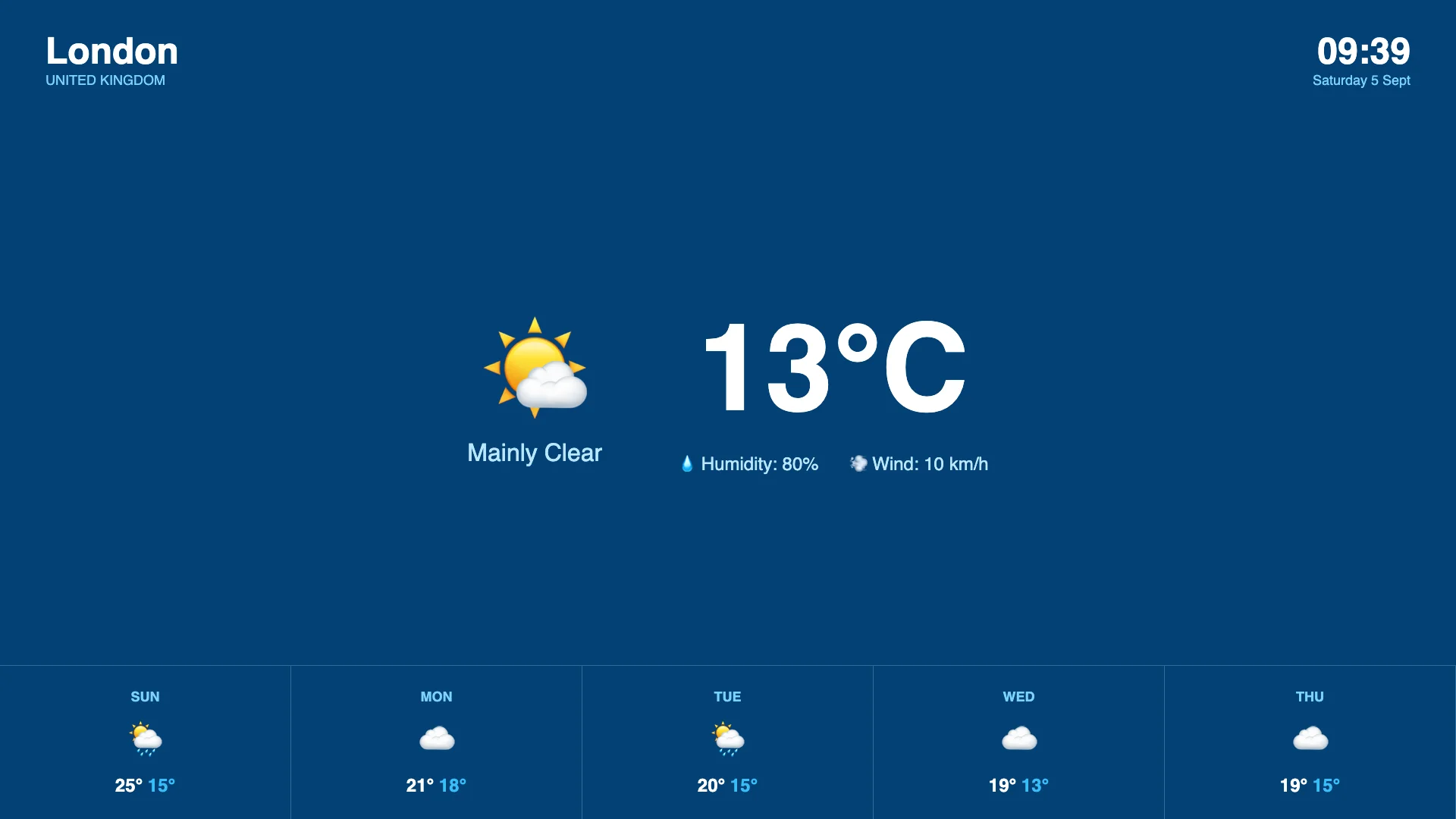
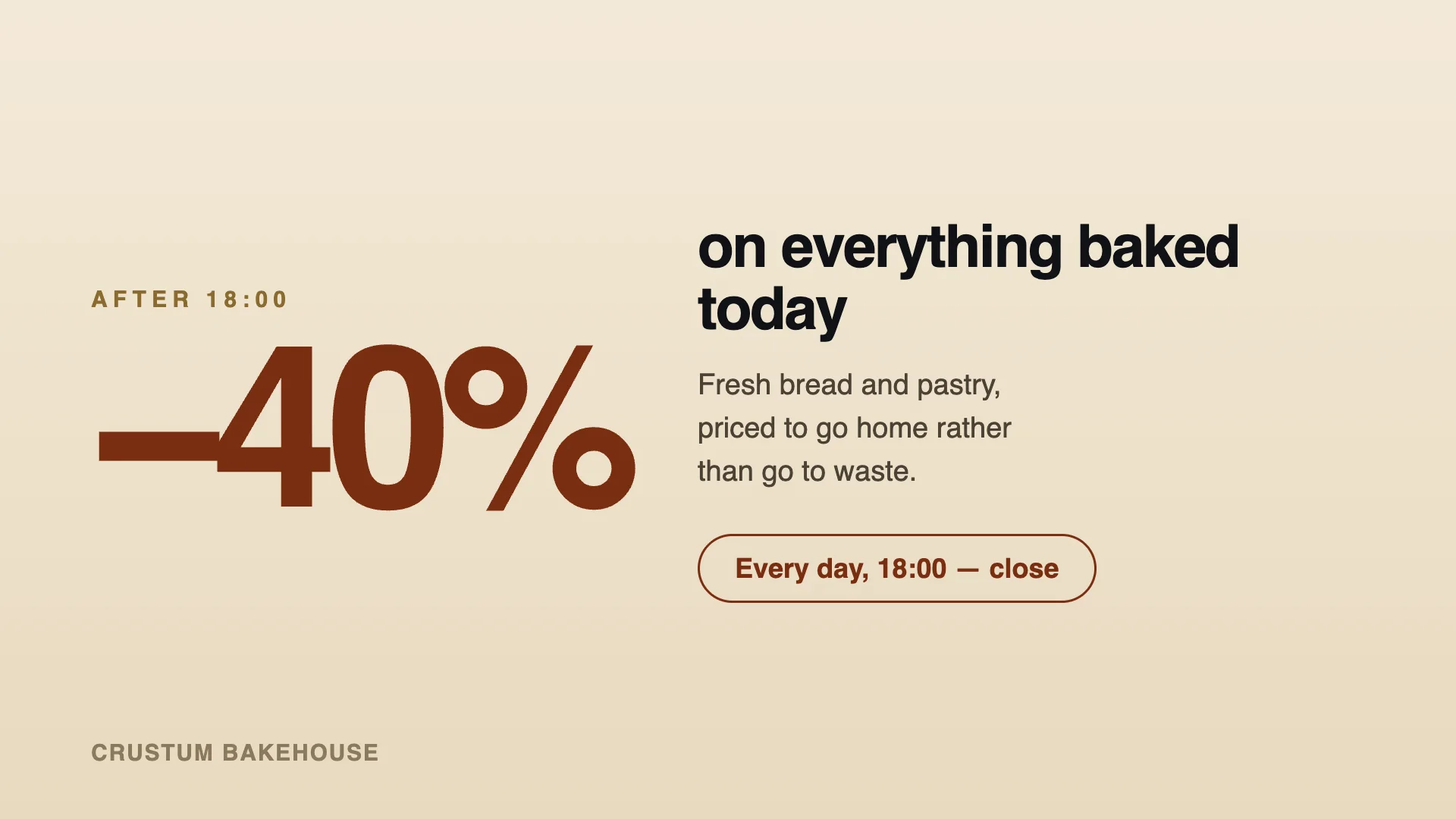
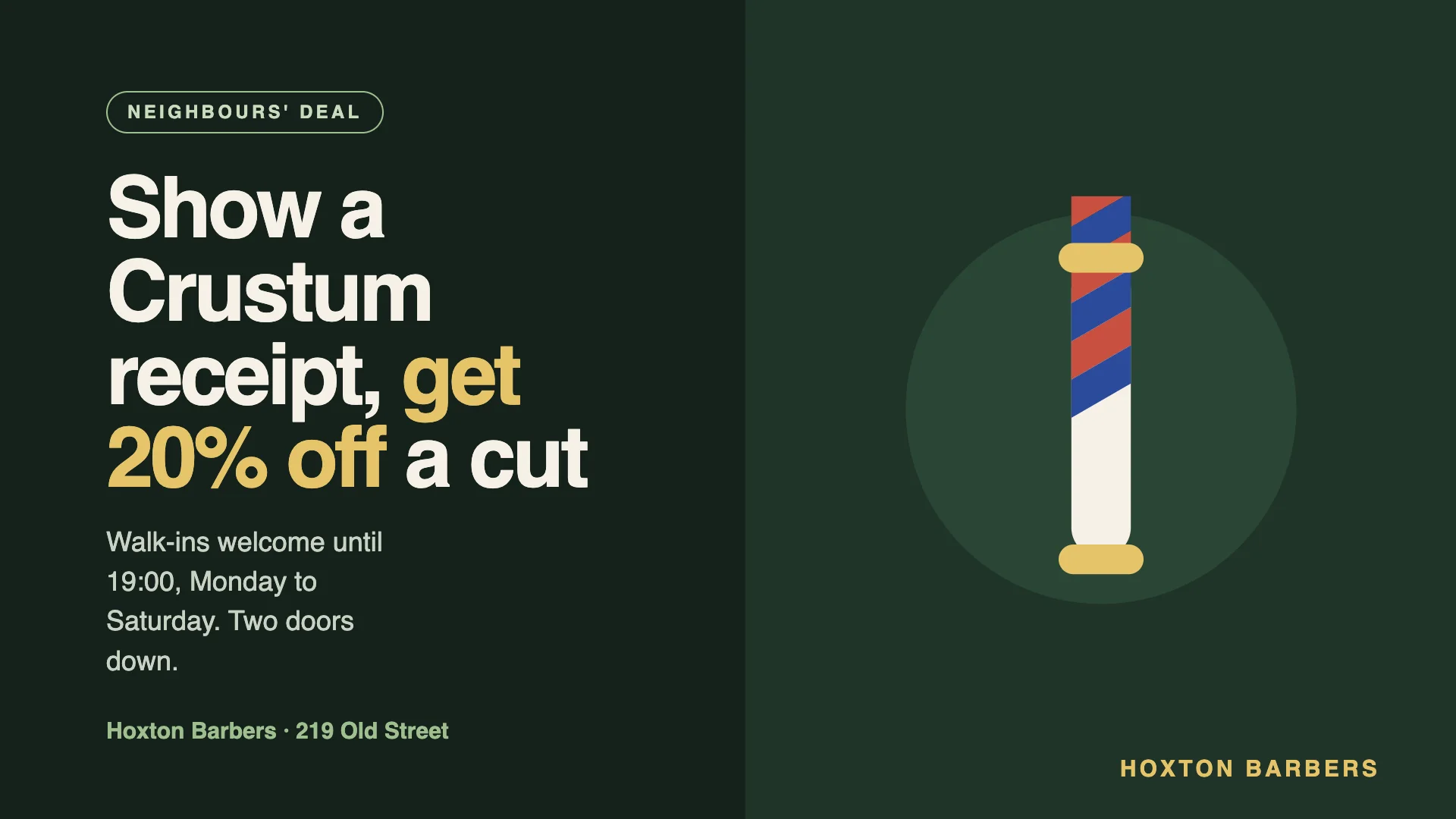
You already own the screens. They just don't do much.
A television behind every counter, a panel at every door. The menu on a printed board, the offer on a poster, the TV on whatever it was left on. Every shop slightly different — and somebody driving round to fix it.
Is that screen even on right now?
Nobody knows until a customer says so.
The price changed. Again.
Nine shops, nine phone calls, nine printed boards.
I'm not buying a box for every TV.
A player per screen is a second estate to look after.
Ten minutes per screen. Nothing to buy.
Open the ScreenRoll app on the TV — Samsung, Windows or macOS — or cms.screenroll.live/tv on any other smart TV. It shows a code. Type the code in your dashboard, pick the shop. That is the whole installation.
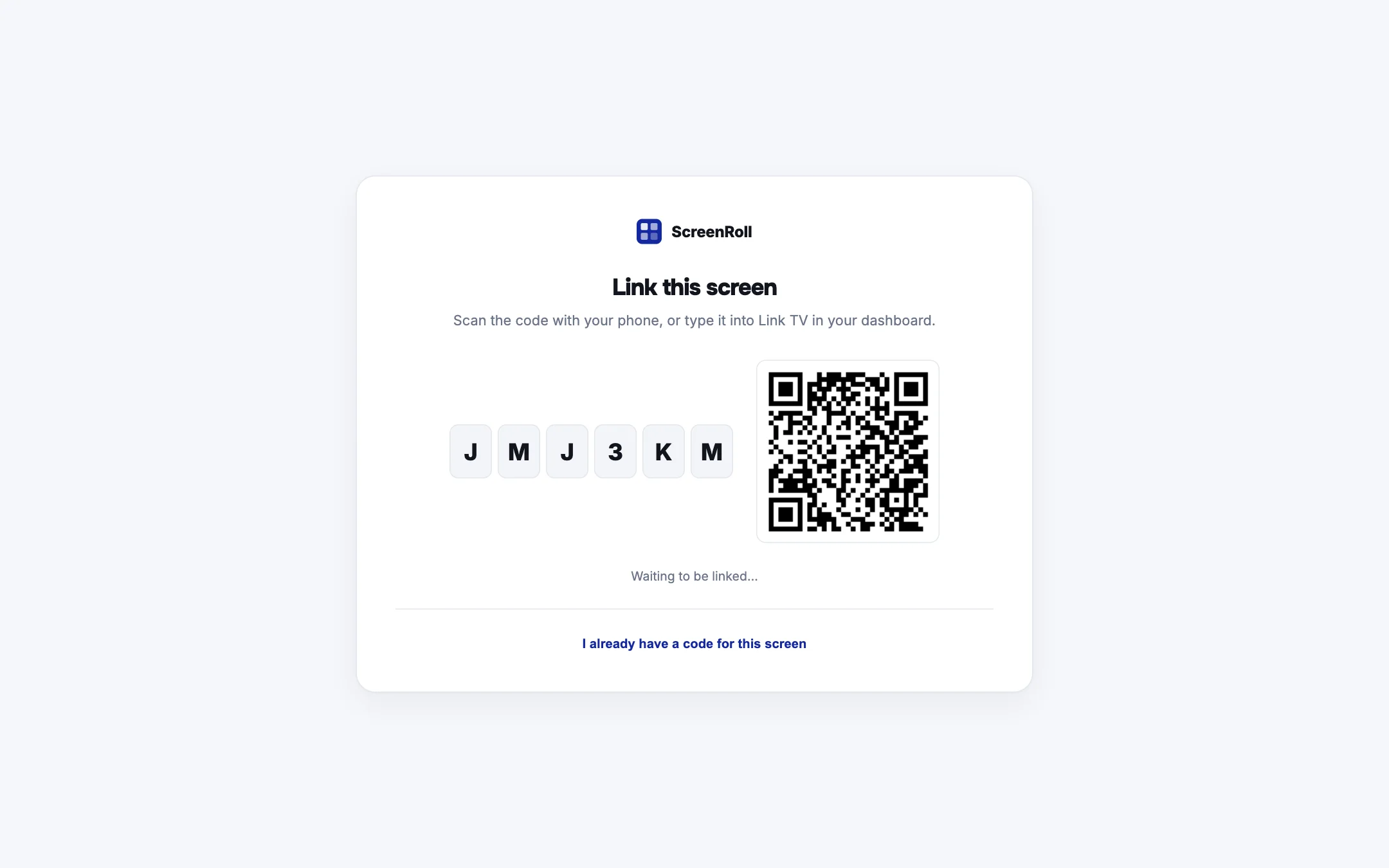
Open the app on the TV
A code appears:A7K2M9
Type it in the dashboard
Or scan the QR with your phone. Pick the screen it becomes — or create a new one on the spot.
It starts playing
Within seconds, and it remembers the pairing through every power cut.
| Device | How | Status |
|---|---|---|
| Samsung TV (Tizen) | The ScreenRoll TV app: full screen, panel kept awake. Starts with the set on Samsung business displays. | Available |
| Windows 10 and 11 | Installer, no admin rights, starts with Windows, video walls and LED rectangles. | Available |
| Windows 7 and 8 | A separate build for older boxes, 64- and 32-bit. | Available |
| macOS | Apple silicon and Intel. Unsigned for now: the first launch needs right-click → Open. | Available |
| Any other smart TV | Open cms.screenroll.live/tv on the television. Nothing to install. | Available |
| Linux · Raspberry Pi | AppImage. Until then, Chromium in kiosk mode. | Soon |
| Android · Android TV | Until then, cms.screenroll.live/tv on the television. | Soon |
Downloads and install steps live in the Help Center. The player inside each app updates itself on every release.
Tell every screen what to show, and when
Upload the menu, the offer, a video. Put them in a playlist. Give the playlist its hours, its days and a target: one screen, one shop, or every menu board in London. The 11:00 change then happens by itself, in every shop, within a few minutes of the hour.
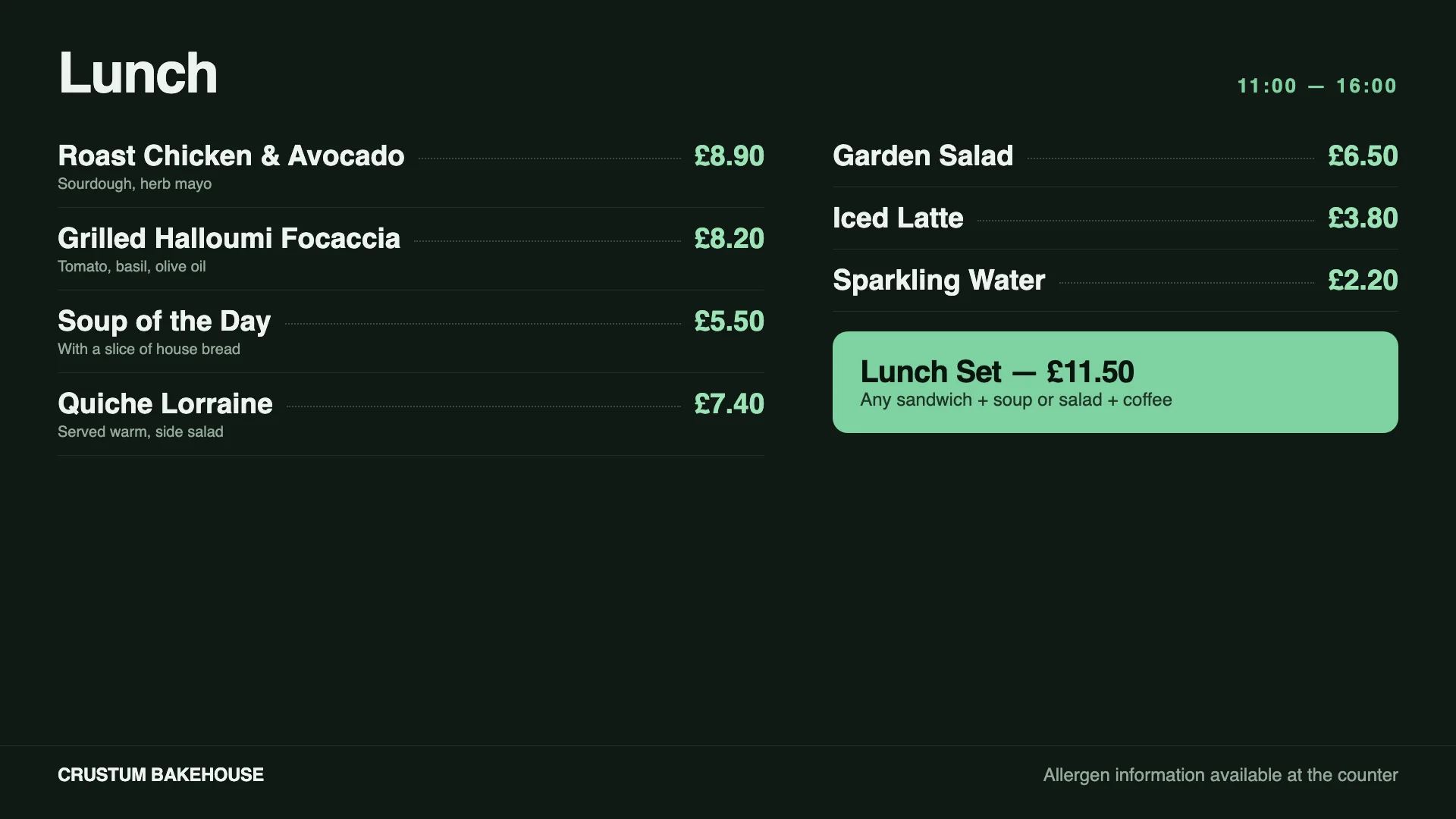
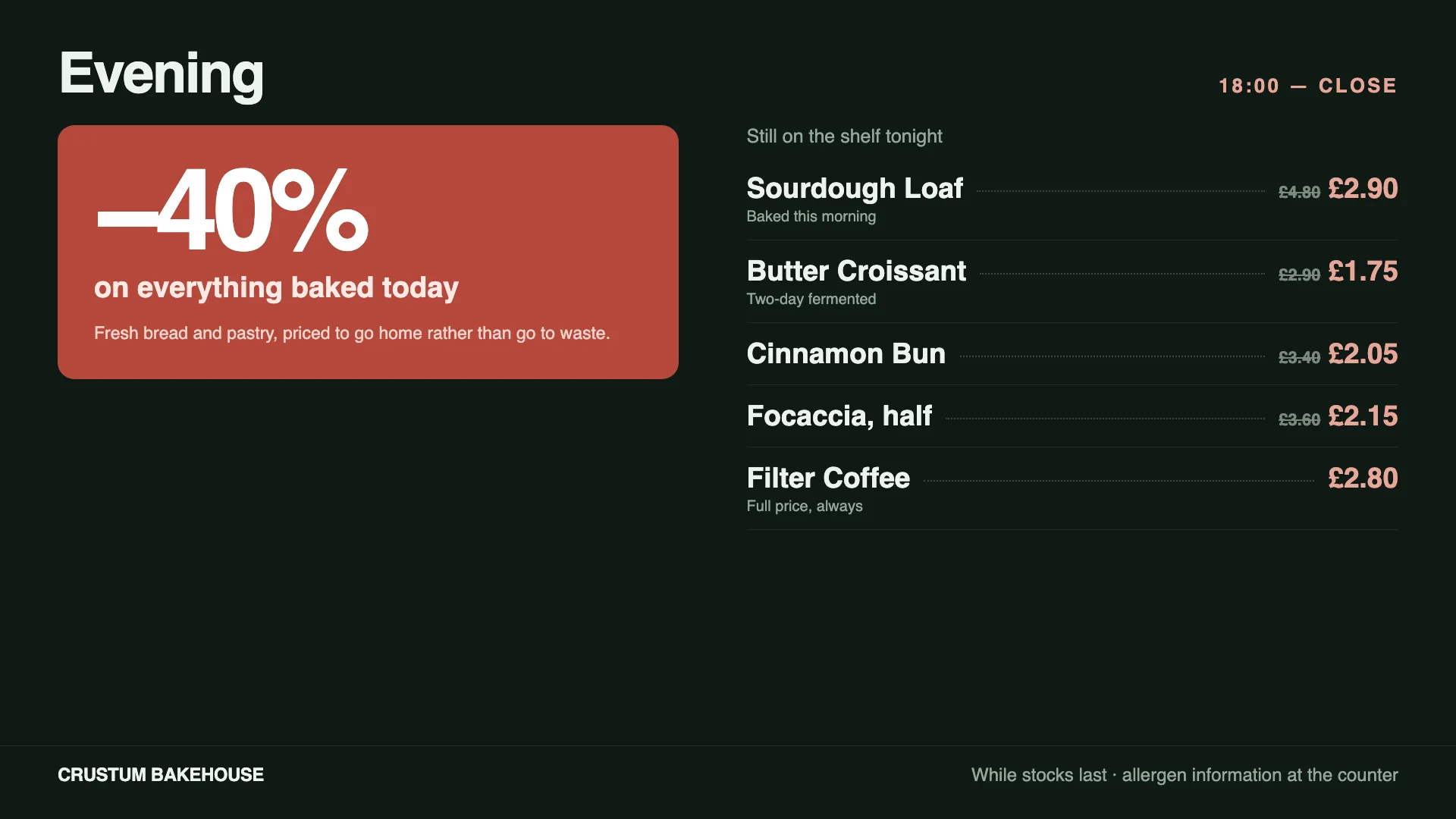
A more specific rule wins: a lunch window beats an all-day loop, one screen's rule beats its group's.
See every screen from the office — or the phone
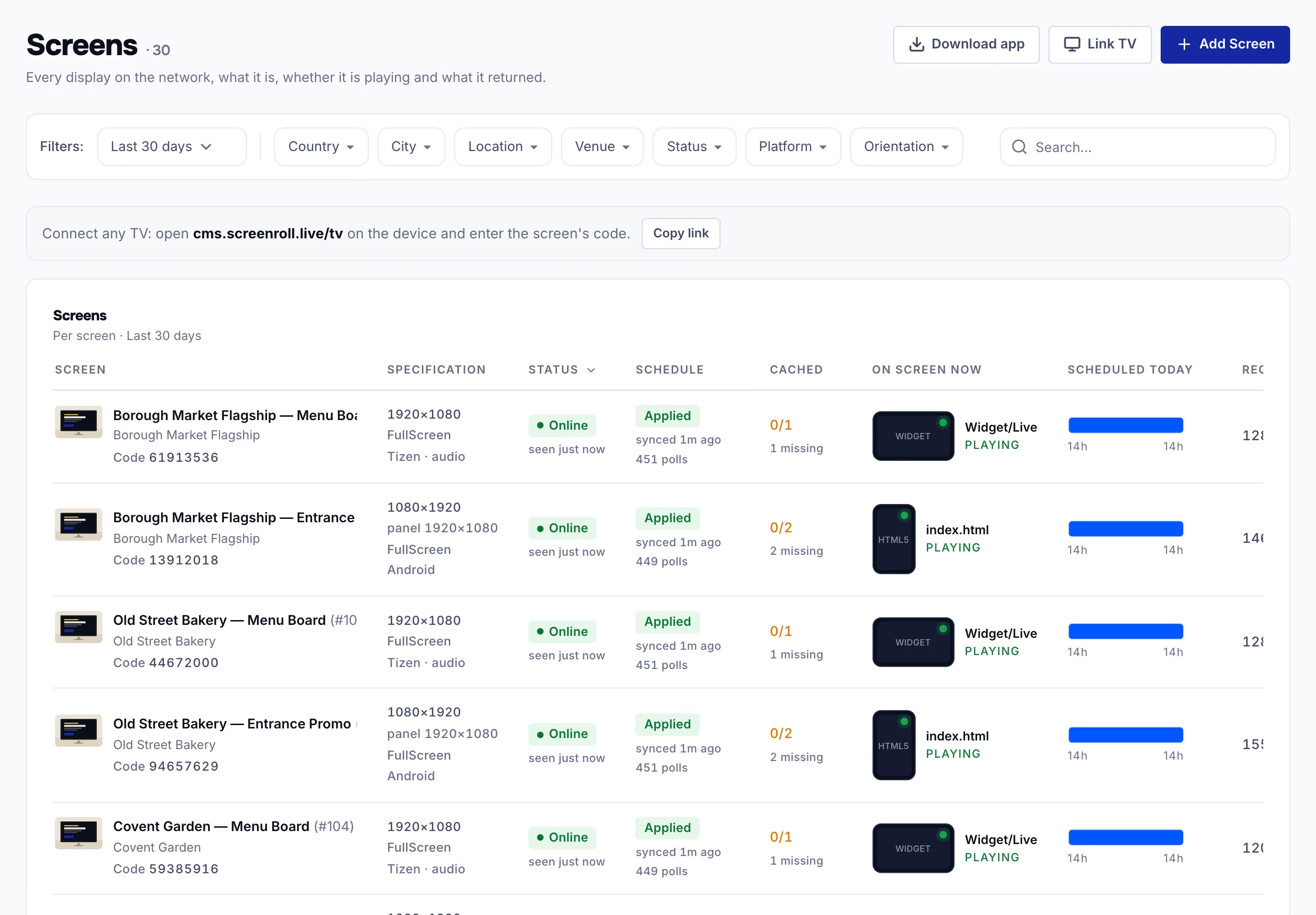
Is it on? What is it showing this second? Did it get the new menu? The list answers before anyone has to call.
- Online, offline, since whenA dead screen is a row you notice from the office, not a call from the shop.
- Cached before you need it"3 / 4 · 1 missing" — you know before the outage, not after.
- On screen nowEach screen reports the file it is playing this second, beside its status. "Is it even on?" — answered.
Every site on a map, with its audience
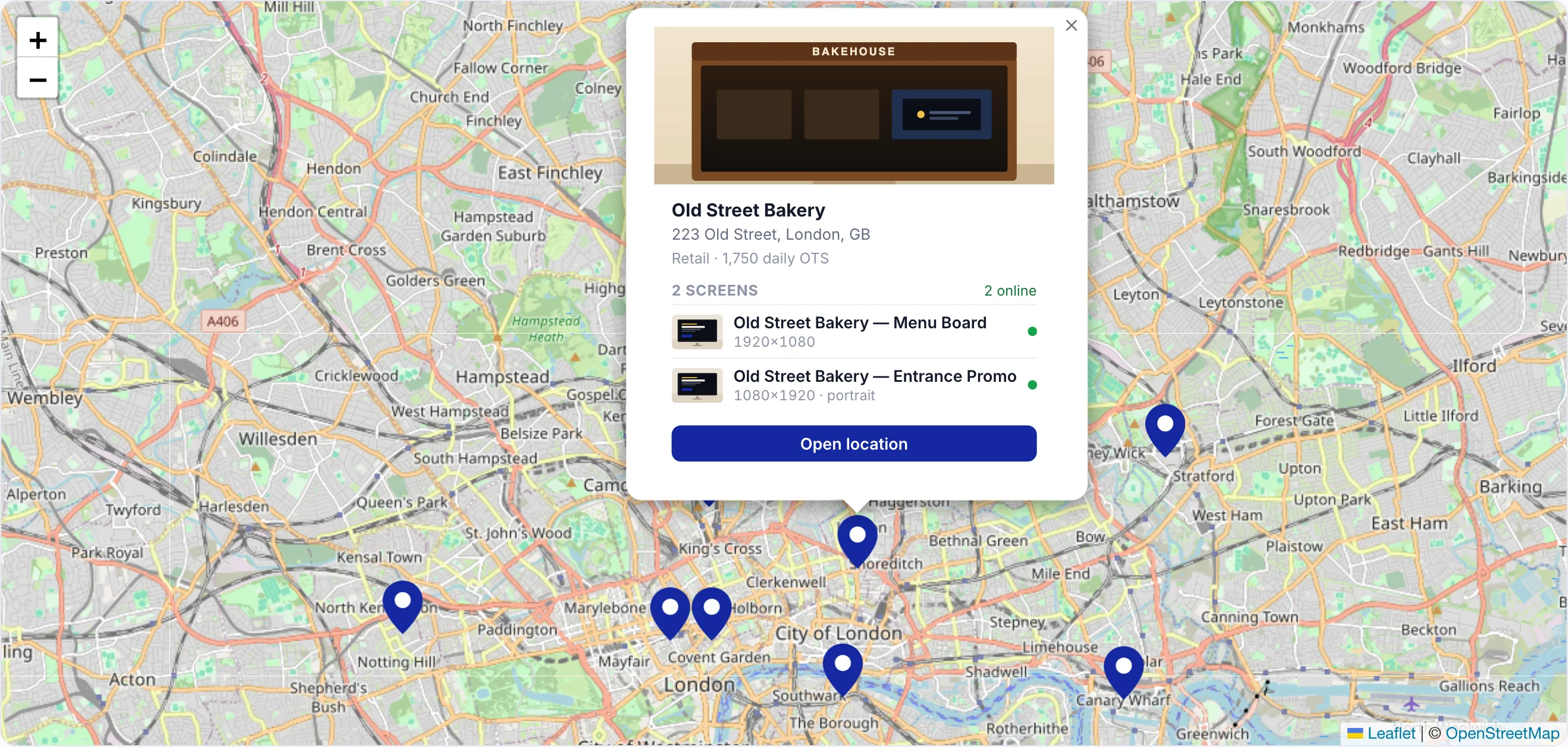
Each shop with its address, its daily visitors and the screens inside it. Click a pin and the site opens. It is the view an advertiser asks to see first.
| Site | Screens | Daily visitors | Right now |
|---|---|---|---|
| Borough Market Flagship | 2 | 2,100 | 2 live |
| Old Street Bakery | 2 | 1,750 | 2 live |
| Covent Garden | 2 | 1,900 | 2 live |
| … and twelve more, in London and Manchester | 24 |
The Wi‑Fi drops. Nothing happens.
Files and the schedule live on the screen itself. Seven days without a line, plays counted locally and reported when it returns. A broken file is skipped, never shown as a black frame.
Inside the player: what a screen keeps, and how it rides out an outage →
- OnlineThe line goes down
The router in the shop reboots. The screen carries on; a small offline marker in the corner is the only change.
- OfflineThe menu stays up
The schedule it already has keeps playing from its own cache, and every play is counted locally.
- OnlineBack, and caught up
Every play is reported with the time it happened, and the next daypart takes over.
A daypart that was due to start during the outage takes over once the screen checks in again. The same holds if the outage is at our end, or if a payment fails: playback is never held hostage.
Numbers an advertiser would pay for
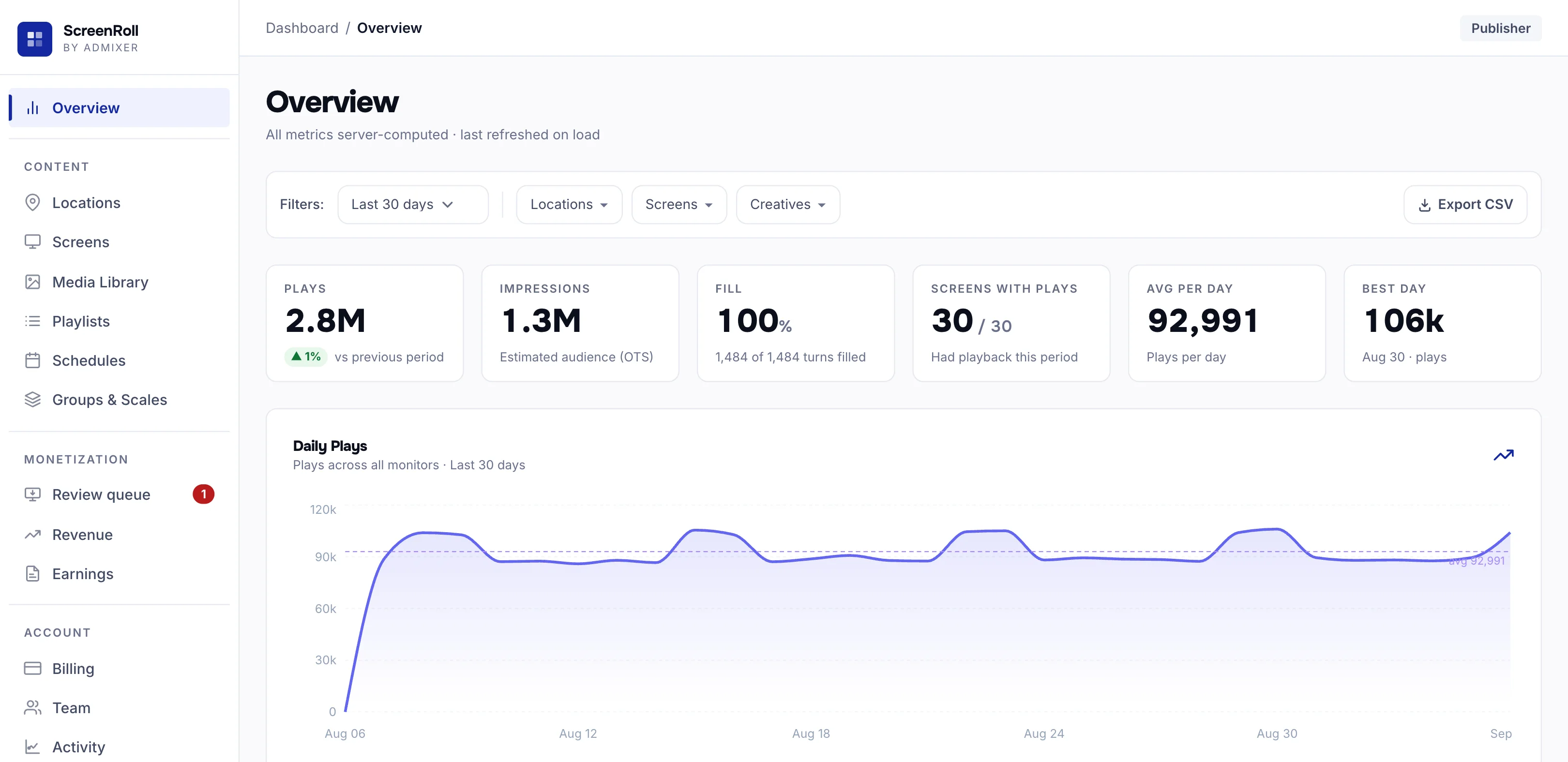
Plays, impressions, fill — per screen, per day, per creative, exporting as CSV. A paid play is counted only when the screen confirms the ad rendered, so the revenue report and the payout agree.
Unsold screen time can pay for the rest
Put an ad slot in a playlist. Advertisers bid for each play; your policy decides who may appear; you set the floor price. Only what reached the glass is counted. Payouts monthly.
- An ad slot is a hole in your playlist. Ten seconds, wherever you like.
- Buyers bid for each play in about a third of a second. Below your floor, your own content plays instead.
- Your policy decides who appears. Refused categories are never even bid on; the rest waits for you with a preview.
- Only what reached the glass is counted. Revenue by day, screen and advertiser.
Who can advertise here
SR-K7WM3QX9A team, with their own keys
Unlimited users. A marketing manager edits playlists and never sees billing; an installer adds screens and nothing else. Two-step sign-in for everyone; every change logged with a name and a time.
| Who | Media | Playlists | Schedules | Screens | Locations | Analytics | Billing |
|---|---|---|---|---|---|---|---|
| Emily MarsdenOwner | Edit | Edit | Edit | Edit | Edit | Edit | Edit |
| Andrew PriceMarketing | Edit | Edit | — | View | View | View | — |
| Joanna DunneOperations | — | View | Edit | View | View | View | — |
| Ryan StoneInstaller | — | — | — | Edit | Edit | — | — |
Nobody shares a password. Someone leaves: disable them, and their name stays on every change they made.
The same story behind other doors
Change the menu for a class timetable, a queue, a listing or a model film. The chapters are the same.
- Bakery, café
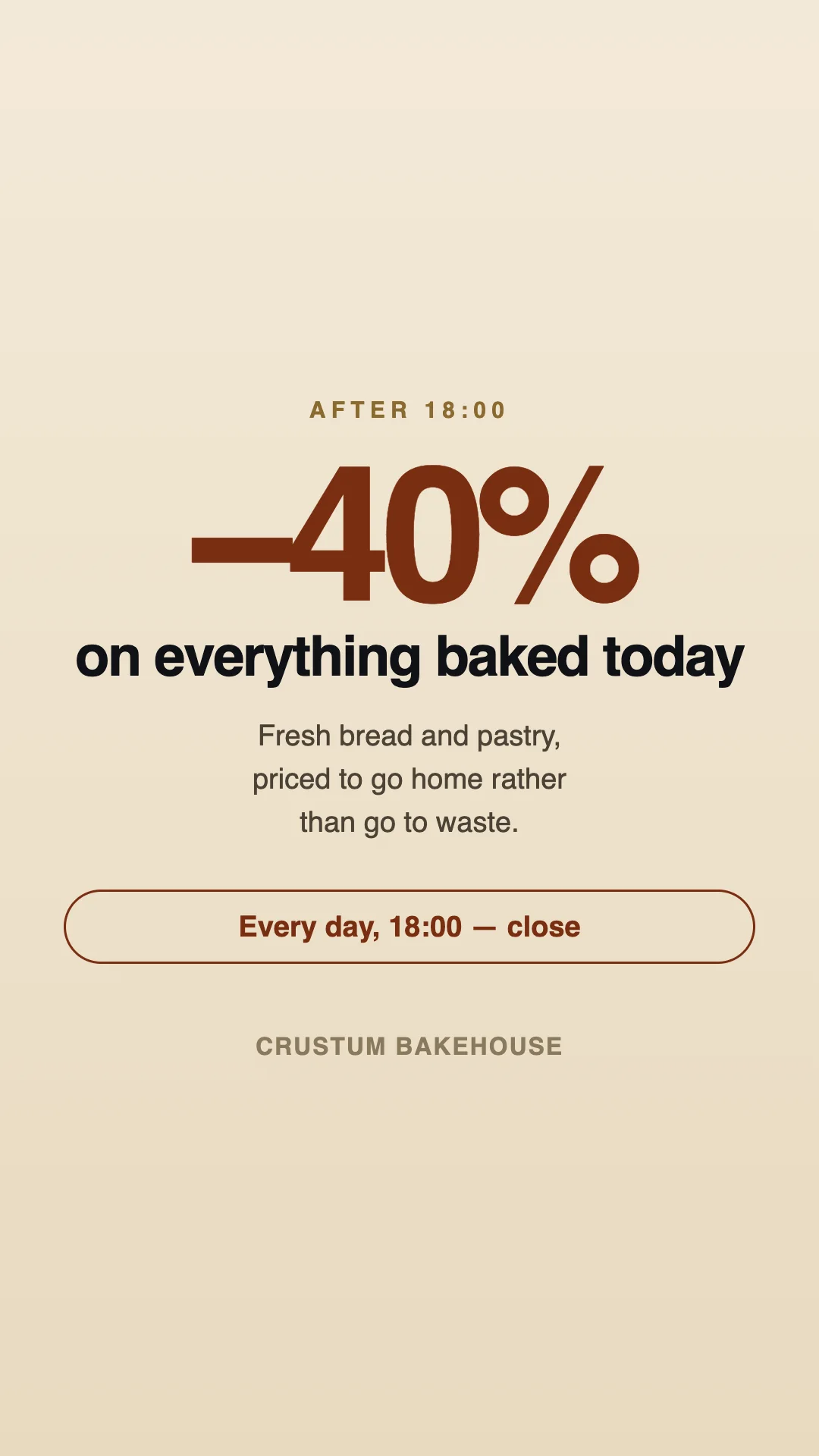
Breakfast menu until 11, lunch after, −40% after 18:00. Change a price once; every shop updates.
- Gym
Class timetable, trainer clips, sponsor ads in a slot. Music from an audio zone, silent at night.
- Pharmacy, clinic
Health tips and the queue, sound off. Policy: alcohol, gambling and tobacco never appear.
- Shopping mall
A 2×2 video wall at the entrance, portrait totems per floor, auctions filling the gaps at your floor price.
- Hotel
Lobby: welcome, weather, today's events. Each meeting-room door shows its own bookings.
- Restaurant
Lunch and dinner boards for both locations. "Kitchen closed" at 21:30, scheduled once.
- Real estate window
Listings in portrait, 24/7, street-facing. Plays from cache all weekend, office Wi-Fi or not.
- Car dealership
4K model films on the wall, a queue widget at the service desk, insurance partners only in the ad slot.
- Office, campus
News feed and KPI board in the lobby; each floor edits its own. One alert to every group, instantly.
- Supermarket
Checkout screens and aisle endcaps. Promotions change by the hour; every branch, one edit.
- Taxi, fleet
A screen per cab: the route, the city's ads, the driver's tip line. Plays from cache the whole shift.
- DOOH network
Billboards and totems for hire. Every play sells in auction at your floor price, with proof of play per screen.
What it costs
One price per screen, and the tier follows your count. The first screen is free — every feature, no card, no end date. Storage is pooled: 250 MB for the free screen, plus 2 GB for every paid one.
- Unlimited users, playlists, schedules
- Every layout, video walls, all media kinds
- Seven-day offline playback
- Samsung, Windows and macOS apps
- Ad slots and auctions included
- Your own ad tags served at $0.15 per 1,000 plays
- Invoiced monthly, paid by bank transfer
If a payment fails, the dashboard goes read-only. Your screens keep playing — playback is never held hostage to billing.
Why not a typical signage CMS?
| Feature | Typical signage CMS | ScreenRoll |
|---|---|---|
| Extra hardware | A player box per screen, $80–150 each | None. The TV or PC you have, with the free app |
| Feature tiers | The useful parts sit in Pro or Enterprise | Everything on every plan, the free screen included |
| Price per screen | $8–30 a month | $12, falling to $8 as you grow |
| Users | Often paid per seat | Unlimited, with per-page permissions |
| Storage | A few hundred MB, or "unlimited" with small print | 2 GB per screen, pooled across the account |
| Internet drops | Hours, then a black screen | Seven days from the screen's own cache |
| Ad revenue | Not offered, or a separate platform | Built in: live auctions, your approval, monthly payouts |
| If you stop paying | Screens go dark | Dashboard read-only. Screens keep playing |
"Typical" is the published list pricing and free-plan terms of the leading signage platforms, September 2026. Prices in USD.
Start with one screen
No card, no trial clock, no sales call. Ten minutes from here to a screen that does its job.
- The first screen is free. Paying starts with the second, at $12 a month.
- Nothing to buy. The TV you have, or a Windows or Mac box you have.
- Moving from another system? Ask us about importing your screens in one go — ask@screenroll.live.
What do I need to get started?
The TV or computer you already have. Samsung TVs, Windows and Mac run a free ScreenRoll app; any other smart TV just opens a web page. There is no player box to buy.
Is the first screen really free?
Yes. One screen, every feature, no logo on your content, no card, and no date it stops.
Paying starts with your second screen, at $12 a month.
What does it cost for 10 or 30 screens?
Ten screens cost $90 a month, thirty cost $232 — the first screen is always free, and the price per screen falls as you add more. Users, playlists and schedules are unlimited on every plan.
What happens when the internet drops?
The screen keeps playing. Everything it needs is stored on the screen itself, for up to seven days.
Plays are counted while it is offline and reported when the line comes back.
Can I put my own menu on the screen?
Yes — images, video, and menus or designs exported from any design tool. They are sized to the screen automatically, portrait or landscape, up to 4K. Weather and news panels come built in.
How do my screens make money?
You leave a short gap in your playlist for advertising. Advertisers pay for each time it plays, you set the lowest price you will accept, and you are paid monthly.
It is optional, and off until you choose to switch it on.
Do I decide which ads appear?
Completely. You can review every ad before it plays, block whole categories such as alcohol or gambling, or accept only the categories you want. Nothing you have not allowed reaches your screen.
Can my team have their own logins?
Yes, as many as you need, each with their own rights — a shop manager can change playlists without ever seeing your billing. Every change is recorded with a name and a time.
What happens if I stop paying?
Your screens keep playing. The dashboard becomes read-only until the invoice is settled, and nothing is deleted.
Where is my data kept?
On Microsoft servers in the European Union. Your reports export as a spreadsheet whenever you want them.